New UNDP Report Offers Roadmap for Navigating Uncertainty
𝐓𝐫𝐢𝐧𝐢𝐝𝐚𝐝 𝐚𝐧𝐝 𝐓𝐨𝐛𝐚𝐠𝐨 𝐩𝐮𝐭𝐬 𝐭𝐨𝐩 𝐩𝐫𝐞𝐦𝐢𝐮𝐦 𝐨𝐧 𝐧𝐞𝐰 𝐡𝐮𝐦𝐚𝐧 𝐝𝐞𝐯𝐞𝐥𝐨𝐩𝐦𝐞𝐧𝐭 𝐝𝐚𝐭𝐚 𝐚𝐭 𝐫𝐞𝐠𝐢𝐨𝐧𝐚𝐥 𝐥𝐚𝐮𝐧𝐜𝐡
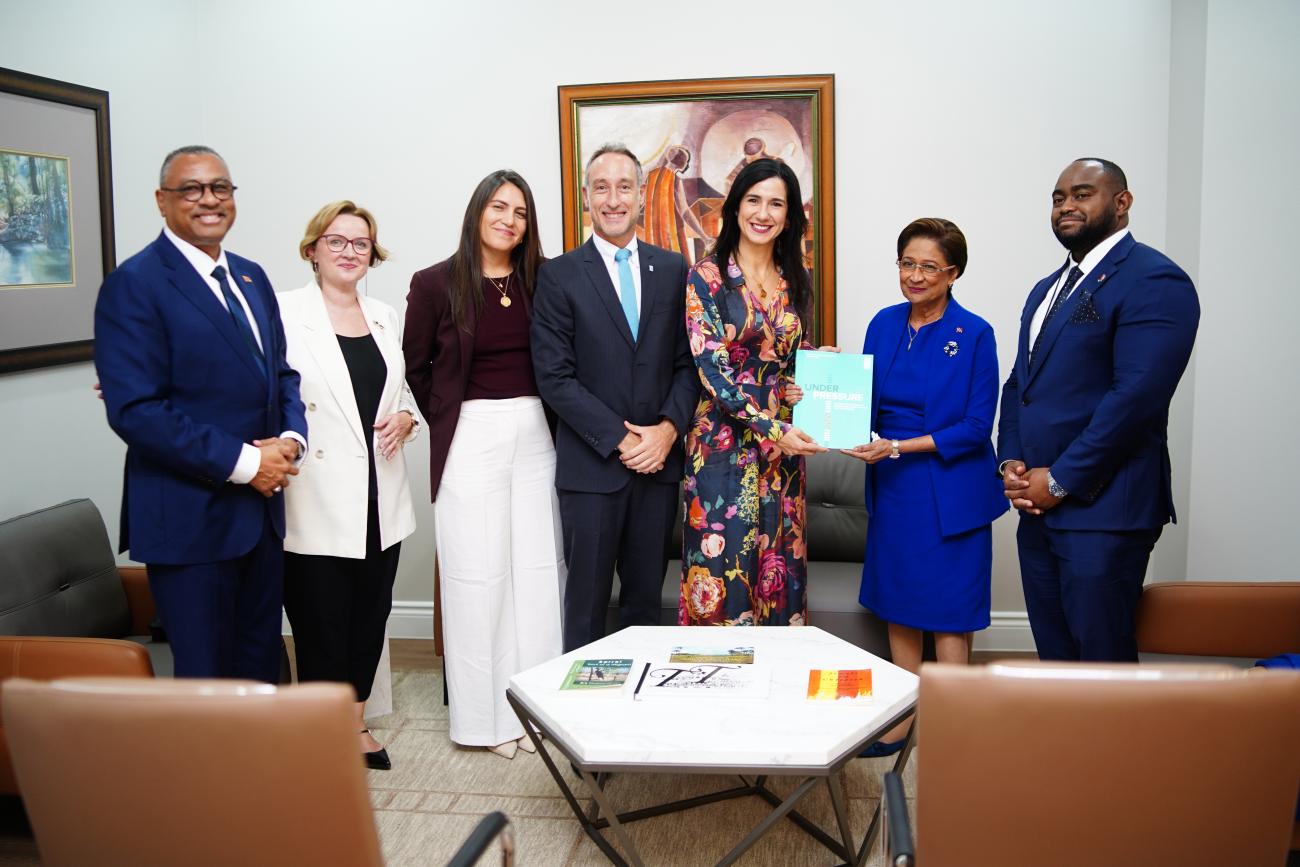
Port of Spain, Trinidad and Tobago — 18 September 2025 – The United Nations Development Programme (UNDP) launched today the 2025 Regional Human Development Report for Latin America and the Caribbean, titled “Under Pressure: Recalibrating the Future of Human Development,” at a high-level event held in Port of Spain, Trinidad and Tobago. The event was hosted by the Honourable Kamla Persad-Bissessar, SC, MP, Prime Minister of the Republic of Trinidad and Tobago, with participation from members of Cabinet, civil society, academia, and international partners.
In a context where the Caribbean and Latin America region faces an era of mounting pressures such as the lingering effects of the pandemic, stronger and more frequent climate-related events, growing debt, economic instability, polarization, and persistent inequalities, the report places resilience at the heart of development policy and practice. It emphasizes that in a time of rising crises, human development can only advance if nations and communities are equipped to anticipate, absorb, and adapt to shocks.
Prime Minister Persad-Bissessar said: “Why should geography determine dignity? The Caribbean knows vulnerability—but we also know resilience. We know how to rise, and we must rise together. Not just for ourselves but for the generations to come. These times of global uncertainty demand proactive strategies. They demand quick action with long-term vision. And that is the kind of leadership I am committed to delivering. This report shines a light on the path forward. It challenges us to recalibrate our development model—to make it more inclusive, more just, and more future-proof. In a region marked by both vulnerability and resilience, it is a timely call to action for leaders, institutions, and communities across the Caribbean.”

While the report acknowledges the Caribbean’s position on the frontlines of these overlapping crises—from hurricanes and rising seas to external economic shocks and fragile institutions, it also presents a message of hope and opportunity, spotlighting the courage and innovation of the region’s people. It emphasizes that development without resilience is no longer viable, and calls for a new development playbook, centered on what it terms the three I’s of resilience:
-
Instruments – Smarter policies and financial tools that protect people and anticipate risks.
-
Institutions – Transparent, inclusive systems capable of responding to crises and rebuilding trust.
-
Infrastructure – Both physical and digital, built to withstand shocks and expand access to opportunity.
Michelle Muschett, UNDP Regional Director for Latin America and the Caribbean emphasized that “Building resilience is not optional—it is a necessity in the world we live in today. And it is a shared responsibility: individuals should not be left to shoulder risks alone; governments cannot manage them in isolation; the private sector cannot innovate in a vacuum; and international partners cannot just borrow solutions from outside”. She added, “Nor does resilience emerge automatically as a byproduct of growth or poverty reduction. It must be built—through concrete action, through innovation, through dialogue, through trust. It requires investing in people, strengthening institutions, and re-imagining the social contract for a new era of uncertainty."
The Human Development Index (HDI) in the Caribbean has increased steadily over the past decades, albeit with temporary setbacks after the 2010 Haiti earthquake and the pandemic. As seen in LAC, its pre-pandemic growth rates were higher: the Caribbean's HDI grew at an average annual rate of 0.3% in the five years before 2020 but has slowed to 0.1% afterwards. Trinidad and Tobago shows a different trajectory, with HDI now growing at 0.06% annually, above its pre-pandemic rate of 0%, in part due to a recent years of setbacks and recovery.
The report also underscores the transformative role of digital technologies in building resilience noting that true digital resilience is not just about cables and code—but about ensuring that technology strengthens governance, expands opportunity, and protects rights. Yet the report warns that the benefits of digitalization remain unevenly distributed across the Caribbean. In a region where fewer than 4 in 10 households have access to a computer, the report calls for a shift from basic connectivity to inclusive digital ecosystems that empower all people to thrive in a digital age. It highlights the importance of investing in digital public infrastructure, such as secure digital IDs and interoperable platforms, while building digital skills and ensuring access to affordable devices, especially for rural and marginalized communities.

The report highlights the importance of a renewed social contract—one that reduces inequality, strengthens civic trust, and protects the freedoms central to the human development approach: the freedom to live healthy lives, to learn, to earn a living, and to participate fully in society.
As the region confronts an increasingly unpredictable future, the 2025 Regional Human Development Report offers a roadmap for navigating uncertainty—and a bold invitation to reimagine development—not as a linear path, but as a resilient journey shared across generations, sectors, and borders.
The digital version of the report also offers interactive resources, including country-level data, animated graphics, practical policy inputs, and a Chatbot with AI-powered tools for quick consultations on the report’s content.
For more information and media inquiries, please contact:
-
Sharon Grobeisen, Strategic Communications Advisor – sharon.grobeisen@undp.org
-
Vanessa Hidalgo, Regional Communications Advisor – vanessa.hidalgo@undp.org
-
Jabarry Garnes, Communications Analyst (Trinidad and Tobago) – jabarry.garnes@undp.org


UN entities involved in this initiative
Other entities involved in this initiative
Goals we are supporting through this initiative